
Why Epoxy Garage Floors Peel (Hot Tire Pickup) and How to Prevent It
By Thousand Oaks Epoxy Floors · Updated · 5 min read
Epoxy garage floors peel for four main reasons: poor surface prep (acid etching or no grinding), hot tire pickup on a soft or thin topcoat, moisture vapor pushing up through the slab, and coating over an old failing coating. Diamond grinding, a moisture test before choosing the basecoat, and a polyaspartic topcoat rated for hot tires prevent nearly all of it.
We get called to a lot of peeling floors. Almost none of them failed because epoxy is a bad material. They failed because of what happened, or did not happen, before the first coat went down.
What Is Hot Tire Pickup?
When you drive, your tires heat up, sometimes well over 140°F on a summer freeway run. You pull into the garage and park. The hot rubber softens the coating under it, and as the tire cools it grips that softened coating. Next time you back out, the tire pulls a patch of coating with it. You see it as bare concrete spots exactly where your tires sit.
It shows up most with:
- Water-based, one-part or very thin DIY coatings.
- Floors that were acid-etched instead of ground, so the bond is weak to begin with.
- Plain epoxy topcoats that soften more with heat than polyaspartic.
- Newer tires with softer compounds, and performance tires.
In Simi Valley, Moorpark and Agoura Hills, where summer afternoons run hot and people come off the 101, 118 and 23 at speed, we see more of it than near the coast.
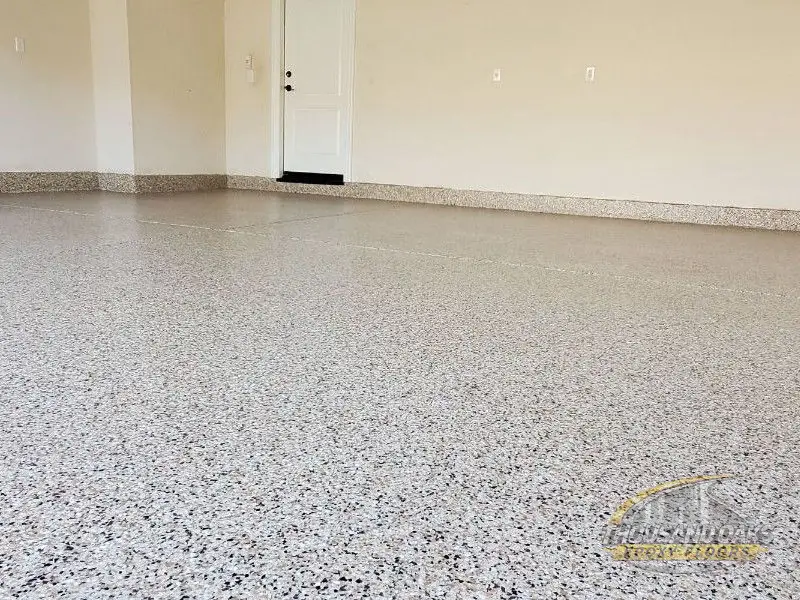
Why Does Prep Matter So Much?
Concrete straight from the builder is smooth, dense and often has curing compound on top. A coating rolled over that sits on the surface instead of gripping into it. Acid etching, the method on most DIY kit boxes, removes a little cement paste but leaves an uneven, often contaminated surface, and the acid residue itself can interfere with adhesion.
Diamond grinding with a planetary machine removes the top layer, curing compounds, old sealers and contamination, and leaves a uniform profile like coarse sandpaper. The basecoat soaks into that and locks in mechanically. It is slower, dustier and needs equipment, which is why cheap installers skip it. It is also the single biggest predictor of whether a floor lasts.
How Does Moisture Make a Floor Peel?
Concrete is porous. Slabs on the ground, especially older ones without a plastic vapor barrier under them, continually pass water vapor upward. Bare concrete just breathes it out. Put a non-breathable coating on top, and that vapor builds pressure under it. You get blisters, white haze, then delamination.
Signs your slab may have moisture:
- Dark patches that come and go
- White powdery efflorescence along cracks or edges
- Dampness under a rubber mat or cardboard box
- Musty smell in a closed garage
We meter every slab at the estimate. Higher readings mean a moisture-tolerant epoxy primer or the 5-layer flake build with a dedicated clear moisture barrier as its own first coat. Moisture mitigation is priced as prep because not every slab needs it.
Why Do Floors Peel Near the Garage Door?
Three reasons stack up at the door: the most sun (UV breaks down plain epoxy), the most water (rain and irrigation run in), and the most tire turning. If a coating was not carried right to the edge and sealed at the threshold, water gets under the edge and the peeling spreads inward.
Can You Coat Over an Old Peeling Floor?
No. A new coating is only as strong as what it is stuck to. If the old floor is lifting anywhere, the bond is failing, and painting over it just adds weight to a layer that is already letting go. Old coatings have to be ground off completely. That is one of the prep items that can push a flake floor toward the top of its range, alongside glue or adhesive removal, advanced crack repair, demo of an existing floor, moisture mitigation and extra labor.
| Cause | What you see | How we prevent it |
|---|---|---|
| No grinding / acid etch | Large sheets lifting | Planetary diamond grind every slab |
| Hot tire pickup | Bare spots at tire positions | Polyaspartic hot-tire-rated topcoat |
| Slab moisture | Blisters, white haze | Moisture reading; MVB primer or 5-layer build |
| Coated over old coating | Peeling in patches, old color showing | Full removal before coating |
| Thin topcoat | Wear-through in lanes | Measured coats; 4-layer double topcoat option |
| Edge not sealed | Peeling from threshold inward | Coat to edge, detail threshold |
How Do I Prevent Hot Tire Pickup on My Floor?
If you are installing new:
- Make sure the slab will be diamond-ground. Ask directly.
- Ask what the topcoat is. You want polyaspartic or a similar aliphatic, not a plain epoxy top.
- Ask whether they take a moisture reading.
- Wait the full 48–72 hours before parking.
If you already have a floor and are worried:
- Park on a rubber mat in summer if your coating is a DIY kit.
- Let the car cool for a few minutes before pulling into the garage after a long drive. This genuinely helps weak coatings.
What Does It Cost to Fix a Peeling Floor?
The fix is removal plus a new system. The new system is priced the same as any floor, flake at $6.50–$10 per sq ft, or $2,600–$4,000 for a typical two-car garage, plus coating removal as a prep item. Patch repairs on a failing floor rarely last; the surrounding coating usually keeps letting go. We will tell you honestly at the estimate whether yours can be saved with a recoat or needs to come off. See the 2026 cost guide for the full price list.
Does Tire Type Matter?
A little. Performance and summer tires use softer rubber that grips more aggressively when hot, so sports-car owners see pickup on weak coatings sooner. All-season truck tires are harder but heavier. A properly bonded system with a polyaspartic topcoat handles both; the difference only shows up on floors that were marginal to begin with.
The Real Takeaway
A peeling floor is almost never bad luck. It is skipped prep, the wrong top layer, or a moisture problem nobody measured. Before you hire anyone, read our 10 questions to ask a garage floor company, and if your DIY kit is already lifting, call us for a free look. We work across Thousand Oaks, Simi Valley, Agoura Hills and the rest of the Conejo Valley.
Frequently Asked Questions
What causes hot tire pickup on garage floors?
Hot tires soften a weak or thin coating, then grip it as they cool. When the car backs out, the coating lifts. It mostly affects acid-etched floors, DIY kits and plain epoxy topcoats.
Why is my epoxy garage floor peeling?
The most common causes are no diamond grinding, hot tire pickup, moisture vapor from the slab, and coating over an older failing coating. Most peeling floors need full removal and a new system.
Can you put new epoxy over old peeling epoxy?
No. The old coating must be ground off completely, or the new floor will fail along with it. Coating removal is quoted as a prep item.
How do I prevent my garage floor from peeling?
Insist on diamond grinding, a moisture test, and a polyaspartic topcoat rated for hot tires, then wait 48–72 hours before parking.