
Epoxy vs Tile vs Polished Concrete vs Paint for Garage Floors
By Thousand Oaks Epoxy Floors · Updated · 5 min read
For most Southern California garages, a professionally installed epoxy flake system ($6.50–$10 per sq ft here) gives the best mix of durability, looks and easy cleaning. Paint is cheapest but wears fast. Interlocking tiles install quickly and come with you when you move but trap grit and water. Polished concrete is very durable but does not hide stains or cracks on older slabs.
We install coatings, so we have a bias. But we also do grind and seal, which is close to polished concrete, and we see plenty of tile and paint jobs when we come to remove them. Here is how the four compare in the conditions we actually work in: older slabs, hot inland summers, coastal moisture, and sun through an open door.
Quick Comparison Table
| Epoxy flake system | Interlocking tiles | Polished / ground-and-sealed concrete | Garage floor paint | |
|---|---|---|---|---|
| Installed cost (typical) | $6.50–$10/sq ft | Material-driven; varies widely | Grind and seal $6.50–$9/sq ft | Lowest; mostly materials |
| Install time | 1 day | Hours to 1 day | 1–2 days | 1–2 days plus dry time |
| Hides stains and cracks | Yes, fully | Yes, covers | No | Partly |
| Hot tire resistance | Very good with polyaspartic top | Good; tiles can shift | Excellent | Poor |
| Water and grit | Sits on top; hose off | Gets under tiles | Sits on top | Sits on top until it wears |
| Moisture-prone slabs | Needs MVB primer or 5-layer build | Traps moisture underneath | Handles vapor well | Peels |
| Typical life | 15+ years | Depends on product | Very long; reseal periodically | 1–3 years |
Epoxy Coatings: Pros and Cons
Pros: seamless, easy to clean, stain-resistant, hides an ugly slab, wide color choice, textured options for grip, one-day install for flake.
Cons: upfront price, prep is critical, smooth gloss can be slippery when wet, and a bad install has to be ground off.
Cost here: flake $6.50–$10 per sq ft, which is $2,600–$4,000 for a typical two-car garage; solid color $9.50–$11.50; metallic $12.50–$18.50. Prep such as old coating removal, glue removal, advanced crack repair, demo, moisture mitigation and extra labor is priced on top when the slab needs it. See the 2026 price guide.
Interlocking Garage Tiles: Pros and Cons
Polypropylene or PVC tiles snap together over the concrete.
Pros: no cure time, DIY-friendly, removable if you move, hide stains and cracks, some have drainage channels.
Cons: water, sand and oil get underneath and sit on the concrete where you cannot clean it; some tiles expand in heat and buckle in hot garages; hard plastic can be loud and slick when wet; seams collect dirt; a full two-car set of quality tiles is not cheap.
Good for: renters, people who move often, workshops where you want to roll up a section and get to the slab.
Polished Concrete and Grind and Seal: Pros and Cons
True polished concrete is ground through progressively finer diamonds and densified until it shines. Grind and seal is the faster, more affordable version: ground and sealed with a clear coating.
Pros: extremely durable, nothing to peel, handles slab moisture better than film coatings, modern industrial look.
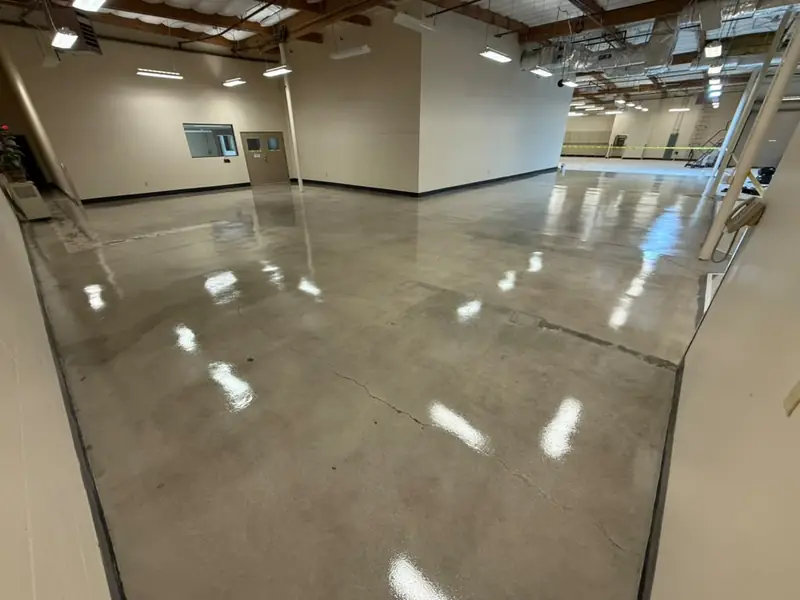
Cons: shows every stain, crack, patch and color variation in the slab. Older garage slabs, with years of oil and a few cracks, rarely look like the photos. Not much grip when wet on high polish.
Good for: newer slabs in good condition, lofts, retail, warehouses, and anyone who likes the raw concrete look. Grind and seal with us is $6.50–$9 per sq ft, or $2,600–$3,600 for a two-car garage.
Garage Floor Paint: Pros and Cons
One-part latex or epoxy-fortified paint rolled onto the slab.
Pros: cheapest option, any homeowner can do it, quick color change.
Cons: thin, soft and the most vulnerable to hot tire pickup; peels in the tire lanes; stains through; needs redoing every year or two; and when you want something better, it has to be ground off first.
Good for: a storage room or shed, or a very short-term refresh.
Which Is Best for Hot Inland Garages?
In Simi Valley, Moorpark and Agoura Hills, heat is the main enemy. Paint and thin coatings pick up under hot tires. Some plastic tiles expand and lift. A polyaspartic-topped flake system or a ground-and-sealed slab both handle it well.
Which Is Best for Damp or Coastal Slabs?
In Camarillo and lower Newbury Park, moisture vapor is the issue. Tiles trap it underneath. Paint blisters. Grind and seal breathes better than a film. A coating works if the system is built for it: a moisture-tolerant epoxy primer or our 5-layer flake build with a dedicated clear moisture barrier. We meter every slab before recommending one.
What About Rubber Mats?
Rubber roll-out mats are a fine add-on in a home gym or under a workbench. As a whole-garage floor they trap moisture and smell, and they stain the concrete underneath. Many of the "glue removal" line items we price come from old glued rubber flooring.
What About Resale?
Buyers see a coated or sealed garage as finished. Paint that is peeling reads as deferred maintenance. Tiles are neutral and often leave with the seller. We do not promise a resale number for any of them.
How Should You Choose?
- If you park daily and want it easy to clean: epoxy flake.
- If you rent or move often: tiles.
- If the slab is newer and clean and you like concrete: grind and seal or polished.
- If you are just refreshing a shed: paint.
- If you want a showroom look: metallic or solid color epoxy.
Our Take After Removing a Lot of Old Floors
The floors we tear out most often are painted garages and thin DIY coatings. Tiles we pull up usually look fine on top and dirty underneath. Ground-and-sealed slabs rarely need us at all except for a reseal. Coated floors that were installed properly rarely need us either, apart from a topcoat refresh years later. The lesson is less about which product wins and more about prep: anything bonded to a slab that was not properly ground will eventually come loose.
Still not sure? We will look at your slab and tell you which option fits, including when the answer is not a coating. Free estimate across Thousand Oaks and nearby cities.
Frequently Asked Questions
Is epoxy better than tile for a garage floor?
For most daily-use garages, yes. Epoxy is seamless and easy to hose off, while water, sand and oil can collect under interlocking tiles. Tiles make sense for renters or people who want a removable floor.
Is polished concrete cheaper than epoxy?
Grind and seal costs $6.50–$9 per sq ft with us, compared with $6.50–$10 for flake epoxy. The bigger difference is appearance: polished or sealed concrete shows existing stains and cracks, while flake hides them.
Is garage floor paint as good as epoxy?
No. Paint is thinner and softer, wears through in tire lanes and is the most prone to hot tire pickup and peeling. It usually needs redoing every one to three years.
Which garage floor is best for a damp slab?
Grind and seal breathes well, and a coating can work if it uses a moisture-tolerant epoxy primer or a dedicated moisture barrier layer. Tiles and paint tend to trap moisture or blister.