
Commercial Epoxy Flooring: Cost and Options for Conejo Valley Businesses
By Thousand Oaks Epoxy Floors · Updated · 5 min read
Commercial epoxy flooring is quoted per job after a site visit because traffic, chemicals, downtime and slab condition vary so much. As a starting reference, our systems run $6.50–$18.50 per sq ft installed: grind and seal and flake at the low end, solid color and quartz in the middle, metallic at the top. Prep, after-hours scheduling and chemical-resistant topcoats move the final number.
Residential floors are fairly predictable: a two-car garage, a car, some storage. Commercial floors are not. A brewery floor sees hot water and acids, a gym floor sees dropped weights, a salon sees hair dye and chemical spills, and a showroom needs to look perfect under bright lights. The right system depends on the use, and the price follows the system.
What Are the Main Commercial Floor Options?
| System | Reference price | Good for | Notes |
|---|---|---|---|
| Grind and seal | $6.50–$9/sq ft | Warehouses, offices, retail with a concrete look | Lowest cost; shows slab character |
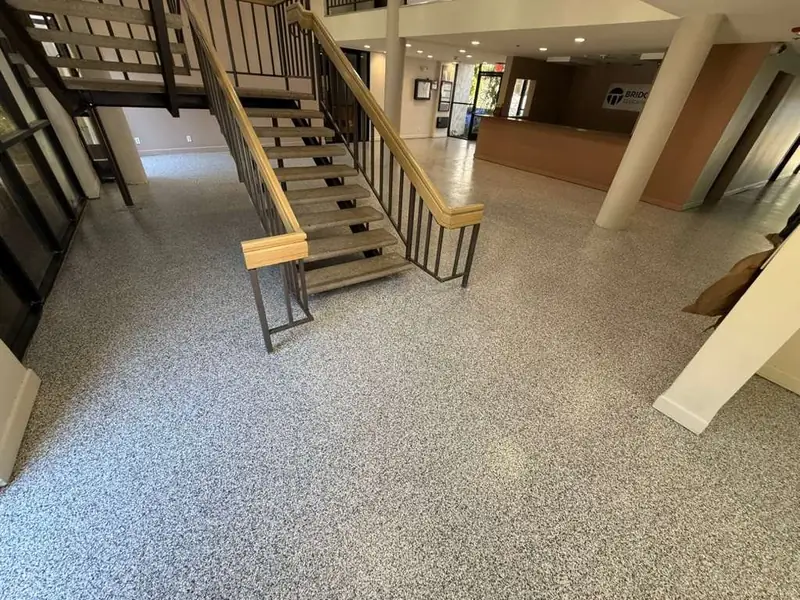
| Flake | $6.50–$10/sq ft | Break rooms, lobbies, back-of-house, light retail | Hides wear; textured |
| Solid color | $9.50–$11.50/sq ft | Workshops, labs, gyms, auto bays | Clean, line-striping friendly |
| Quartz & sand | $9–$16.50/sq ft | Restaurants, wet areas, kennels, locker rooms | Built-in slip resistance |
| Metallic | $12.50–$18.50/sq ft | Salons, boutiques, showrooms, offices | Design statement |
These are the same per-square-foot ranges we use on residential systems. They are a reference, not a quote; commercial work is always priced after a walk-through.
What Drives the Cost of a Commercial Floor?
- Square footage and layout. Large open floors are efficient. Lots of small rooms, columns, drains and equipment pads add labor.
- Existing flooring. VCT tile, carpet, old coatings and mastic have to come off. Demo and glue or adhesive removal are separate prep items.
- Slab condition. Cracks, spalls, joints that need filling, and uneven sections. Advanced crack repair is priced as prep.
- Moisture. Slabs on grade in older buildings often need a moisture mitigation layer.
- Chemical exposure. Restaurants, auto shops and labs may need a chemical-resistant topcoat.
- Slip resistance. Wet areas get quartz or aggregate in the topcoat.
- Schedule. Nights, weekends and phased work to keep you open add labor cost but usually save money overall.
- Extra labor. Cove bases, stairs, ramps, line striping and logos.
Which Floor Fits Which Business?
Restaurants and commercial kitchens
Quartz broadcast systems with a slip-resistant, chemical-resistant topcoat. Pay attention to drains and cove base so water does not get under edges.
Gyms and fitness studios
Solid color or flake in open areas with rubber in the lifting zones. The coating handles foot traffic, sweat and cleaning chemicals; rubber handles dropped plates.
Showrooms and dealerships
Solid color or metallic with a gloss or satin topcoat. These are the floors where prep shows most under bright lighting. Camarillo business parks and Thousand Oaks Boulevard showrooms are typical.
Salons and boutiques
Metallic or high-gloss solid. Hair dye and chemicals need a chemical-resistant topcoat.
Warehouses and light industrial
Grind and seal or solid color with line striping. Forklift traffic needs a thicker build.
How Do You Minimize Downtime?
We plan commercial work around your hours:
- Nights and weekends. Grinding and coating after close; floor back in service by the next opening on fast-cure systems.
- Phasing. Doing half the space at a time so you can keep operating.
- Fast-cure topcoats. Polyaspartic topcoats return to foot traffic in hours instead of days.
- Dust control. HEPA collection on every grinder so inventory and equipment stay clean.
How Do You Keep a Commercial Floor Looking Good?
Auto-scrubbers with soft pads and a neutral cleaner, walk-off mats at entries to catch grit, and a periodic topcoat refresh in high-traffic lanes before wear reaches the color layer. Recoating a worn topcoat on a sound floor costs far less than starting over.
How Is a Commercial Quote Built?
After the site visit, you get a written proposal that separates:
- The floor system, priced per square foot.
- Prep items: coating, tile or glue removal; crack and joint repair; demolition; moisture mitigation.
- Extra labor: after-hours work, phasing, cove base, striping.
- Schedule and return-to-service time.
That makes it easy to compare bids line by line rather than comparing one lump sum against another.
What Should a Commercial Owner Ask Before Hiring?
- What are the product data sheets for every layer?
- How will you handle existing joints and cracks?
- Will you moisture-test the slab?
- How long until foot traffic, and until equipment or vehicles?
- Can you work nights, weekends or in phases?
- Do you carry general liability and workers' comp, and can you name us as additional insured?
Example: Pricing a 1,200 sq ft Retail Space
To show how the ranges work, take a 1,200 sq ft boutique on Thousand Oaks Boulevard with old VCT tile. In metallic at $12.50–$18.50 per sq ft, the system alone is $15,000–$22,200. In a high-gloss solid color at $9.50–$11.50, it is $11,400–$13,800. On top of either: tile demo, mastic grinding, crack repair at a few control joints, and the premium for night work so the store opens on time. Those prep and schedule items are listed separately so the owner can see exactly where the money goes. The same space as grind and seal, if the slab underneath turned out to be presentable, would be $7,800–$10,800 before prep.
How Long Does a Commercial Floor Take?
Small spaces under 1,000 sq ft are often done over a weekend. Larger spaces or multi-coat systems like metallic take three to five working days, or longer if phased. The proposal lists the schedule and when each area returns to foot traffic.
Where Do We Install Commercial Floors?
Throughout Thousand Oaks, Westlake Village, Agoura Hills, Simi Valley, Moorpark and the Camarillo business parks near the airport. See commercial epoxy flooring and Camarillo, or call (805) 521-6591 to schedule a free site visit.
A Note on Code and Inspections
Most commercial floor coatings on existing slabs are cosmetic and do not need a building permit, but food service, healthcare and some industrial uses have health department or tenant-improvement requirements for floor finishes, cove base and slip resistance. Check with your landlord and inspector early; we can supply product data sheets for submittals.
Why Not Just Use the Cheapest Bid?
A failed commercial floor costs far more than a failed garage floor, because you pay for removal, a new system and another round of downtime. When bids differ a lot, the difference is usually grinding versus no grinding, the thickness of each coat, and whether moisture was tested. Ask for each in writing.
Frequently Asked Questions
How much does commercial epoxy flooring cost?
Commercial floors are quoted per job after a free site visit. As a reference, our systems run $6.50–$18.50 per sq ft installed, from grind and seal and flake at the low end to metallic at the top, plus prep and scheduling costs.
Can epoxy floors be installed without closing my business?
Usually yes. We work nights and weekends, phase the work, and use fast-cure topcoats so areas return to service quickly.
What is the best epoxy floor for a restaurant?
A quartz broadcast system with a slip-resistant, chemical-resistant topcoat and proper detailing around drains and cove base.
Do commercial epoxy floors need a permit?
Coating an existing slab is generally cosmetic, but food service, healthcare and some industrial spaces may have health or tenant-improvement requirements. Check with your landlord and local inspector.