
Garage Floor Coating Options Compared: Flake, Solid, Metallic, Quartz and More
By Thousand Oaks Epoxy Floors · Updated · 5 min read
The main garage floor coating options are flake epoxy ($6.50–$10/sq ft, 1 day), solid color ($9.50–$11.50, 3 days), metallic ($12.50–$18.50, 3–4 days), quartz ($9–$16.50, 2–3 days) and grind and seal ($6.50–$9, 1–2 days). Flake is the best all-round choice for daily parking; metallic and solid suit showroom garages; quartz is for wet areas.
There are a lot of names for garage coatings, and some of them are marketing terms for the same thing. This guide sorts them by what actually goes on the floor, what each costs here in Thousand Oaks, and who each is for.
All Options at a Glance
| Option | Per sq ft | Two-car garage | Install time | Best for |
|---|---|---|---|---|
| Flake epoxy | $6.50–$10 | $2,600–$4,000 | 1 day | Daily parking, family garages |
| Solid color | $9.50–$11.50 | $3,800–$4,600 | 3 days | Gyms, workshops, clean modern look |
| Metallic | $12.50–$18.50 | $5,000–$7,400 | 3–4 days | Showroom garages, interiors |
| Quartz & sand | $9–$16.50 | $3,600–$6,600 | 2–3 days | Wet areas, max grip, heavy use |
| Grind and seal | $6.50–$9 | $2,600–$3,600 | 1–2 days | Concrete look, budget, newer slabs |
| Outdoor coatings | $8–$12 | $3,200–$4,800 | 1–2 days | Driveways, patios, pool decks |
All prices include diamond grinding, routine crack filling, materials and labor. Every project starts at $2,600. What can be added on top, when the slab needs it: removing an existing coating or paint, glue or adhesive removal, advanced crack repair, demolition of an existing floor, moisture mitigation, and extra labor or prep.
Flake Epoxy
Pigmented basecoat, vinyl chips broadcast to full coverage, clear polyaspartic topcoat. Comes in three builds: 3-layer (from $6.50/sq ft), 4-layer with a second topcoat and optional sanding and grit, and 5-layer with a dedicated clear moisture barrier (up to $10/sq ft). Hides dust and slab flaws, textured for grip, one-day install.
Choose it if: you park in the garage and want the lowest-maintenance floor. Read more in flake floors: colors and cost.
Solid Color Epoxy
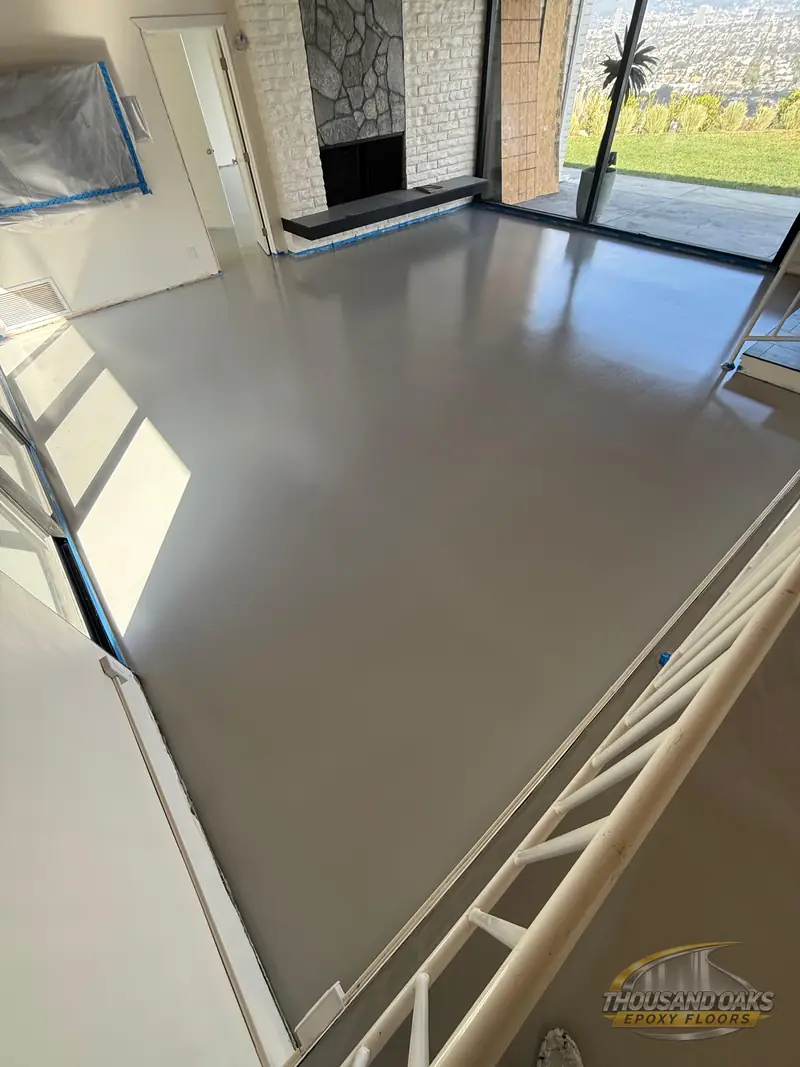
Two pigmented epoxy coats under a polyaspartic topcoat in gloss, satin or matte. Seamless, uniform and easy to line-stripe.
Choose it if: the garage is a gym, workshop or detailing bay and you like a clean look. Mid-gray and tan hide dust best; white and black show the most.
Metallic Epoxy
Hand-poured metallic pigments in clear epoxy, manipulated to create marble or liquid-metal patterns, then topcoated. Every floor is unique.
Choose it if: the garage is a showroom or you are coating an interior. Read metallic floor ideas and prices.
Quartz and Sand Finish
Colored quartz or sand broadcast into the basecoat, sealed and topcoated. The texture is part of the system, so the grip does not wear off like a grit additive can.
Choose it if: the floor gets wet often, such as a garage with a dog wash, a pool-side cabana, a barn or a commercial kitchen.
Grind and Seal
The slab is diamond-ground to a uniform surface and sealed with a clear protective coat. Keeps the concrete look and stops dusting.
Choose it if: your slab is newer and good-looking, or you like industrial concrete. Not a good choice if you want to hide stains.
What About Polyurea and Polyaspartic Floors?
These are names for the resin chemistry, not a different look. Polyaspartic is an aliphatic polyurea. We use it as the topcoat on every flake floor because it is UV-stable and hot-tire-resistant, and sometimes as a pigmented base when UV matters more than moisture. "One-day polyurea floor" usually means a flake system with polyurea or polyaspartic layers. The questions to ask are about prep and layers, not the brand name. See epoxy vs polyaspartic.
What About Garage Paint and DIY Kits?
Cheapest and shortest-lived. Fine for a shed; not for daily parking. Covered in DIY kit vs professional.
How Do the Options Compare on Performance?
| Flake | Solid | Metallic | Quartz | Grind & seal | |
|---|---|---|---|---|---|
| Hides dust | Excellent | Fair | Good | Good | Fair |
| Hides slab flaws | Excellent | Good | Fair | Good | Poor |
| Slip resistance | Good | Fair; grit optional | Fair; grit optional | Excellent | Fair |
| Hot tire resistance | Excellent | Excellent | Good | Excellent | Excellent |
| Looks | Speckled | Uniform | Marble | Textured stone | Raw concrete |
Which Option for Which Garage?
- Family two-car garage, daily parking: 3- or 4-layer flake.
- Older slab with moisture readings: 5-layer flake with its own vapor barrier.
- Home gym: solid color or 4-layer flake with fine grit; rubber in the lifting area.
- Workshop: solid color or flake with 80-grit.
- Collector car showroom: metallic or high-gloss solid.
- Barn, wash bay or dog-wash area: quartz.
- Newer clean slab, minimal budget: grind and seal.
What Changes the Price Within Each Range?
Layer count and slab condition. A clean, dry slab gets the low end of its range. Moisture, old coatings, glue, wide cracks, demo or extra labor push it higher. The free on-site estimate is where we find out which applies and write each one as its own line.
Can You Combine Options in One Garage?
Yes, and it is common. A flake floor in the parking bays with a quartz strip at the dog-wash area, or grind and seal in a storage room next to a coated garage. Combining systems on one visit shares the setup, so it costs less than doing them separately.
Does Location Change Which Option Works?
A little. Coastal Camarillo and lower Newbury Park slabs lean toward moisture-tolerant builds. Hot inland garages in Simi Valley, Moorpark and Agoura Hills make the polyaspartic topcoat non-negotiable. Gated communities in Calabasas, Westlake Village and Hidden Hills mean planning multi-day showroom finishes around HOA work hours. See our service area pages for local details.
What About Outdoor Surfaces?
Driveways, patios, front walks and pool decks run $8–$12 per sq ft with us, or $3,200–$4,800 for a typical 400 sq ft area. Outdoors, everything must be UV-stable, so the system is polyaspartic throughout rather than an epoxy base that will amber in sun. Flake and quartz blends in lighter colors stay cooler under bare feet than dark solids, and grit is standard on pool decks. In HOA neighborhoods, expect to submit a color sample before work starts. More on our outdoor coatings page.
How to Narrow It Down in Ten Minutes
Start with how you use the space, not the look. If cars park there daily, the list is flake or solid. If water is involved, add quartz. If it is a showpiece, add metallic. Then look at your slab: if it is newer and clean, grind and seal joins the list; if it has stains and patches, take it off. Then pick the build within the system based on moisture and how much gloss or grip you want. Two or three options usually remain, and the estimate visit settles it with samples in your own light.
Frequently Asked Questions
What is the best garage floor coating?
For most daily-use garages, a diamond-ground flake system with a polyaspartic topcoat. It hides dirt and flaws, adds grip, resists hot tires and installs in one day for $6.50–$10 per sq ft.
What is the cheapest professional garage floor option?
Grind and seal and the 3-layer flake system both start at $6.50 per sq ft, with every project starting at $2,600.
Which garage floor coating lasts longest?
A properly prepped flake or quartz system with a polyaspartic topcoat typically lasts 15+ years in a home garage, and the topcoat can be refreshed.
Is polyurea the same as polyaspartic?
Polyaspartic is a type of aliphatic polyurea. Both names describe the resin chemistry; we use polyaspartic as the UV-stable, hot-tire-rated topcoat.