
Flake Epoxy Floors: Colors, Cost and Why They Are So Popular
By Thousand Oaks Epoxy Floors · Updated · 6 min read
A flake epoxy floor is a pigmented basecoat covered edge to edge with vinyl color chips, scraped, then sealed under a clear topcoat. In Thousand Oaks it costs $6.50–$10 per sq ft, or $2,600–$4,000 for a typical two-car garage, and most are installed in one day. It is popular because it hides dust, adds grip and forgives imperfect concrete.
If you drive through Lang Ranch or Dos Vientos on a Saturday with garage doors open, most of the coated floors you see are flake. There are good practical reasons for that, and a few things worth knowing before you pick a color.
Why Is Flake the Most Popular Garage Floor?
- It hides dirt. The speckled pattern disguises dust, tire marks and small debris between cleanings. A solid gray floor shows every footprint.
- It hides the slab. Patched cracks, old stains and uneven color in the concrete disappear under a full broadcast.
- It adds grip. The chips give a light texture, which helps when wet tires roll in.
- It is fast. With a polyaspartic topcoat, a two-car garage is done in one day.
- It costs less than showroom finishes. Flake starts at $6.50 per sq ft against $9.50 for solid color and $12.50 for metallic.
What Do Flake Floors Cost in 2026?
| Build | What you get | Per sq ft | Two-car garage |
|---|---|---|---|
| 3-layer | Slab-matched basecoat, full flake broadcast, polyaspartic topcoat | From $6.50 | From $2,600 |
| 4-layer | 3-layer plus a second topcoat (urethane gloss or polyaspartic matte), optional sanding and grit | Mid-range | $2,600–$4,000 |
| 5-layer | Clear moisture barrier, polyaspartic base, flake, topcoat, final coat | Up to $10 | Up to $4,000 |
On top of the layer count, prep can move the number: removing an old coating or paint, grinding off glue or adhesive, advanced crack repair, demolition of an existing floor, moisture mitigation, and extra labor for oil-soaked or uneven slabs. Those are quoted after we look at the floor. The full breakdown is in our 2026 price guide.
Which Flake Colors Are Most Popular in Thousand Oaks?
Our honest ranking from what homeowners actually choose:
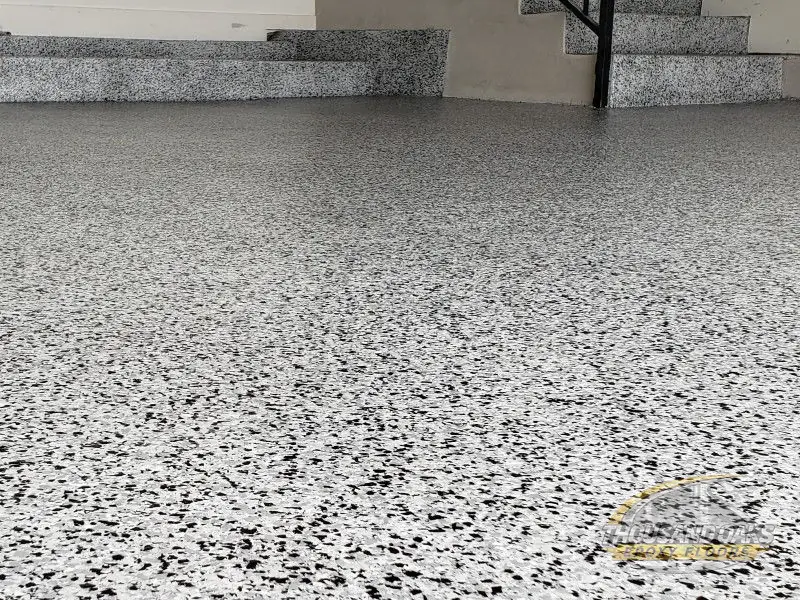
- Gray, white and black blends. The safe pick. They go with any house color and any cabinet system and hide almost everything.
- Tan, brown and cream blends. Popular with Spanish and Mediterranean-style homes and anywhere the driveway is tan. They hide the light-colored dust that blows in during Santa Ana weeks better than grays do.
- Darker charcoal blends. Look sharp with black cabinets, but show white dust and dried water spots more.
- Blue or accent blends. Less common, but great in a game room, kids' space or a car-themed garage.
See every blend we stock on the color chart. Pick two or three favorites from the screen, then look at the physical samples in your own garage during the estimate. Garage lighting changes colors more than you would expect.
Does Flake Size Matter?
Yes. Smaller chips (around 1/8 inch) read as a fine speckle, closer to granite. Larger chips (1/4 inch) look bolder and more mottled. Larger chips hide more but can look busy in a small room. For most two-car garages, a medium chip in a three- or four-color blend is the sweet spot.
Full Broadcast or Partial Broadcast?
We only install full broadcast, meaning chips go down until the basecoat cannot take any more. A partial or "light" broadcast leaves basecoat showing between chips. It uses less material and looks fine in photos, but it is thinner, less textured and shows wear sooner. If a bid is noticeably cheaper, ask about broadcast coverage.
Is a Flake Floor Slippery?
A standard flake floor has a light orange-peel texture from the chips and is not slippery for normal use. For wet areas, ramps or a garage where the dog comes in soaked, the 4-layer build can include aluminum-oxide grit in the topcoat: 240 (fine, barely noticeable), 80 (moderate), or 30 (aggressive, for shops and barns).
How Is a Flake Floor Installed?
- Diamond-grind the slab with a planetary grinder and HEPA dust collection.
- Fill cracks, pits and spalls, then grind the repairs flush.
- Coat the stem walls a few inches up for a clean edge.
- Roll the pigmented basecoat, matched to the slab's moisture readings.
- Broadcast flake by hand until the wet basecoat will not take any more.
- Once set, scrape off the loose and standing chips and vacuum everything.
- Roll the clear polyaspartic topcoat; on 4- and 5-layer builds, a second coat follows.
The scrape step is the one people underestimate. Skipped or rushed, it leaves sharp chip edges standing up through the topcoat. You feel it in bare feet, and dirt catches on it. A properly scraped floor feels smooth with a slight texture.
How Do You Clean a Flake Floor?
Sweep or dust-mop weekly. Mop with warm water and a small amount of pH-neutral cleaner. For oil, a squirt of dish soap and a soft brush. Avoid citrus degreasers, vinegar and strong solvents, which dull the topcoat over time. A rubber squeegee pushes water out the door after you hose it down.
Can You Mix Flake With a Border or Logo?
Yes, though we suggest restraint. A contrasting band along the stem wall, or a darker blend in a parking pad with a lighter blend around it, can look great in a three-car garage. Logos and complex patterns add hand-masking time and a second broadcast, which adds labor. Ask at the estimate and we will price it as a line item so you can decide.
Where Else Does Flake Work?
- Laundry rooms and mudrooms
- Workshops and home gyms (with rubber mats under heavy lifting)
- Entry steps and side yards
- Pool decks and patios with a UV-stable system, see outdoor coatings
- Small commercial spaces like lobbies and break rooms
Flake vs Solid Color vs Metallic
| Flake | Solid color | Metallic | |
|---|---|---|---|
| Hides dust | Best | Least | Moderate |
| Install time | 1 day | 3 days | 3–4 days |
| Two-car price | $2,600–$4,000 | $3,800–$4,600 | $5,000–$7,400 |
| Look | Speckled, granite-like | Clean, uniform | Marble, movement |
| Best for | Everyday garages | Gyms, shops | Showroom garages, interiors |
If you are still deciding, see metallic epoxy and solid color, or read our garage floor options comparison.
What Our Crews Notice on Flake Jobs
The color you pick matters less than you think after a year; the prep matters more. Flake floors that fail almost always fail at the bond, not the chips. Diamond grinding, a moisture reading before choosing the basecoat, and a topcoat rated for hot tires are what keep a flake floor looking good after the novelty wears off.
Want to see blends in your garage? Book a free estimate anywhere in Thousand Oaks, Moorpark, Camarillo or the rest of the Conejo Valley.
Frequently Asked Questions
How much does a flake epoxy floor cost?
In Thousand Oaks, flake epoxy costs $6.50–$10 per sq ft installed, or $2,600–$4,000 for a typical two-car garage up to 400 sq ft. The range reflects the number of layers and any extra slab prep.
What flake color hides dirt best?
Medium blends with gray, white and black or tan and brown chips hide dust and tire marks best. Very dark blends show light dust and water spots.
Does a flake floor need to be sealed?
The topcoat is the seal. Every flake floor we install has a clear polyaspartic topcoat over the chips; the 4- and 5-layer builds add a second coat.
Can flake be installed in one day?
Yes. Most two- and three-car garages are ground, coated, broadcast and topcoated in one working day. You can walk on it that evening and park after 48–72 hours.