
Epoxy vs Polyaspartic Garage Floors for Southern California
By Thousand Oaks Epoxy Floors · Updated · 6 min read
For a Southern California garage, the best floor uses both: epoxy as the basecoat because it bonds deeply into ground concrete and tolerates some slab moisture, and polyaspartic as the topcoat because it is UV-stable, resists hot tires and cures in hours. A floor that is only epoxy will amber in sun; one that is only polyaspartic can struggle on damp slabs.
People ask this as if it were an either/or decision, mostly because some installers sell "one-day polyaspartic floors" and others sell "100% solids epoxy" as if the other one were a mistake. In practice they are good at different jobs, and the climate here makes the difference matter more than it does in, say, Ohio.
What Is the Difference Between Epoxy and Polyaspartic?
Epoxy is a two-part resin that cures slowly, usually overnight or longer. Because it stays liquid for a while, it soaks into the pores of a freshly ground slab and locks in. It builds thickness well and is relatively forgiving of a little moisture coming up from below. Its weakness is sunlight: aromatic epoxies turn yellow or amber with UV exposure, and a plain epoxy surface is softer and scratches more readily.
Polyaspartic is a type of aliphatic polyurea. It cures fast, often walkable in a few hours, it does not yellow in sunlight, and it is harder and more abrasion-resistant at the surface. Its weaknesses are a short working time, which makes it unforgiving for inexperienced installers, and less tolerance for slab moisture when it is the only layer touching the concrete.
| Property | Epoxy | Polyaspartic |
|---|---|---|
| Bond to concrete | Excellent, penetrates ground slab | Very good on dry slabs |
| UV / sun stability | Ambers over time | Stays clear |
| Hot tire resistance | Fair alone | Very good |
| Cure to walk on | 12–24 hours | 2–6 hours |
| Moisture tolerance | Better (moisture-tolerant versions exist) | Lower as a first coat |
| Best role | Primer / basecoat | Topcoat / wear layer |
Why Does Southern California Change the Answer?
Three local things push us toward the combined system.
Sun. Garage doors in Thousand Oaks are open a lot. Afternoon sun reaching the first four or five feet of floor will yellow an epoxy topcoat within a couple of years. You see it as a darker band near the door. Polyaspartic stays clear.
Heat. Summer days in Simi Valley, Moorpark and Agoura Hills get into the high 90s and beyond. A tire coming off the 101 or the 118 is hot, and it softens weak coatings. When the car leaves, the softened coating lifts with the tire. That is hot tire pickup, and a polyaspartic topcoat over a properly ground slab resists it.
Moisture. Older slabs, especially 1960s and 70s homes in Newbury Park and central Thousand Oaks, were often poured without a vapor barrier underneath. Closer to the coast, as in Camarillo, the ground stays damp. A moisture-tolerant epoxy primer handles that vapor better than polyaspartic laid straight on the concrete.
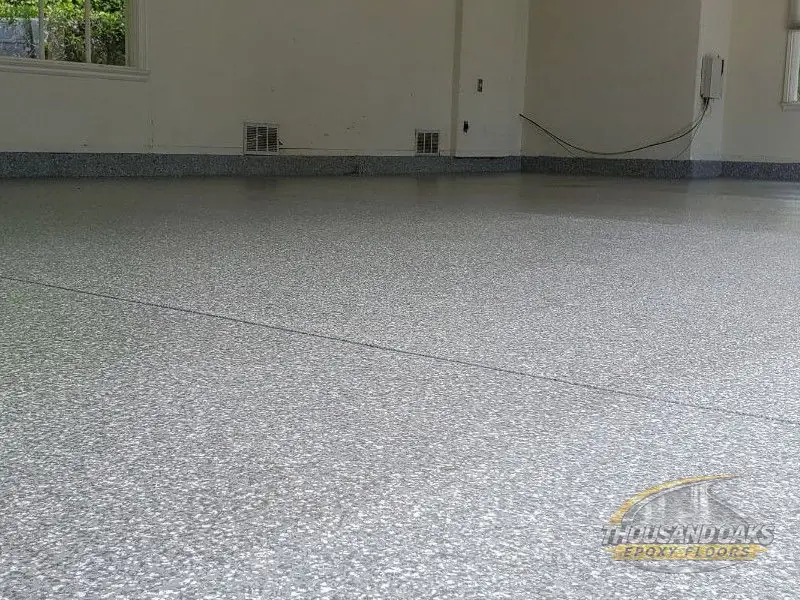
Is Polyaspartic Better Than Epoxy?
As a topcoat, yes, in our climate. As the layer touching the concrete, not necessarily. Polyaspartic sets so fast that it has less time to wet into the pores of the slab. On a perfectly dry, well-ground slab it bonds well. On a slab that is pushing moisture, a moisture-tolerant epoxy first coat is the safer choice.
That is why our flake systems match the basecoat to the slab. When the concrete needs moisture protection, we use a moisture-vapor-barrier epoxy as the base. When UV exposure matters more than moisture, such as a garage that faces west with the door open all afternoon, we may use a pigmented polyaspartic base instead. Every flake system we install finishes with a UV-stable, hot-tire-rated polyaspartic topcoat. The 5-layer build goes further, with a clear moisture barrier as its own first layer.
Does Polyaspartic Cost More?
The material does cost more per gallon, and it takes a more experienced crew because the working time is short. But since it lets us finish a flake floor in one day instead of two or three, the total installed price often ends up similar. Our flake floors with a polyaspartic topcoat run $6.50–$10 per square foot, or $2,600–$4,000 for a typical two-car garage. See the full 2026 price guide for every system.
What About "One-Day" Floors? Are They Rushed?
A one-day floor is fine if the prep is not rushed. The time savings come from polyaspartic curing fast, not from skipping grinding. What you want to confirm on any one-day bid:
- The slab is diamond-ground, not acid-etched.
- Cracks are filled and ground flush, not just covered.
- Someone takes a moisture reading before choosing the basecoat.
- Flake is broadcast to full rejection, then scraped and vacuumed before the topcoat.
If those happen, a one-day floor holds up. If a crew shows up at 9 a.m. and leaves at 1 p.m. with a two-car garage done, something was skipped.
When Would You Pick Epoxy Only?
For an interior floor with no sun and no cars, such as a basement-style room, a storage area or a workshop with no windows, an epoxy build with an epoxy or urethane topcoat can be perfectly fine and a little cheaper. Metallic floors also rely on epoxy for the pour, because its long working time is what lets us move the pigment around. They still get a protective topcoat. See metallic epoxy floors.
When Would You Pick Polyaspartic Only?
For outdoor surfaces like patios, pool decks and driveways where UV is constant and the slab is dry, a full polyaspartic system works well. On our outdoor coatings we use UV-stable materials throughout because plain epoxy outdoors will amber.
How Do I Tell Which Product a Contractor Is Using?
Ask for the product data sheets for every layer and read the first page of each. The sheet will say epoxy, polyaspartic, polyurea or urethane, and it will list solids content and recoat times. A real installer will hand these over without fuss. Also ask how thick each coat goes down, measured in mils. A thin topcoat of any chemistry wears through faster in the tire paths. If the answer is "it's our proprietary blend" with nothing in writing, treat the bid with caution. You do not need to become a chemist; you only need to see that the base, the broadcast and the top are each named and each has a job.
The Bottom Line
Do not choose a contractor by which chemical they say is better. Choose the one who can tell you which layer each product goes in and why. In Southern California, that answer is almost always an epoxy or moisture-tolerant base, a full flake broadcast, and a polyaspartic top.
Frequently Asked Questions
Is polyaspartic better than epoxy for a garage floor?
As a topcoat in Southern California, yes: it is UV-stable, resists hot tire pickup and cures in hours. As the first coat on concrete, a moisture-tolerant epoxy is often the safer choice. The strongest garage floors use epoxy underneath and polyaspartic on top.
Does epoxy turn yellow in the sun?
Standard aromatic epoxy ambers with UV exposure, usually showing first near the garage door. A UV-stable polyaspartic topcoat prevents that.
Can I drive on a polyaspartic floor the next day?
You can walk on it the same evening, but we still recommend waiting 48–72 hours before parking so the full system reaches its working hardness.
How much does a polyaspartic garage floor cost in Thousand Oaks?
Our flake floors with a polyaspartic topcoat cost $6.50–$10 per sq ft, or $2,600–$4,000 for a typical two-car garage up to 400 sq ft.