
How Long Does an Epoxy Garage Floor Last, and When Can You Drive on It?
By Thousand Oaks Epoxy Floors · Updated · 6 min read
A professionally installed, diamond-ground epoxy garage floor with a polyaspartic topcoat typically lasts 15 years or more in a residential garage, and the topcoat can be refreshed rather than replacing the whole floor. On our one-day flake floors you can walk on it the same evening, park after 48–72 hours, and the coating keeps hardening for about a week.
Those are the two questions we hear most on estimates, usually in the same breath: "How long will it last?" and "When do I get my garage back?" Both answers depend on what goes into the floor and how it is installed, so here is the detail behind them.
How Many Years Does a Garage Floor Coating Really Last?
There is a wide range out there because "epoxy floor" covers everything from a $120 hardware-store kit to a multi-layer commercial system.
| Floor type | Typical residential lifespan | Usual way it fails |
|---|---|---|
| One-coat water-based DIY kit | 1–3 years | Peels at tire paths, wears through |
| Single-coat solvent epoxy, acid-etched | 3–6 years | Hot tire pickup, yellowing near door |
| Ground slab, epoxy base, epoxy top | 7–12 years | Scratching, ambering in sun |
| Ground slab, epoxy or MVB base, full flake, polyaspartic top | 15+ years | Topcoat dulls in traffic lanes; recoatable |
The big jump in lifespan comes from two things: diamond grinding, which gives the coating something to grip, and a polyaspartic topcoat, which takes the abrasion and UV instead of the color layer underneath. Neither is optional if you want a floor that outlasts your car.
What Wears a Garage Floor Out?
In Conejo Valley garages, these are the culprits in roughly the order we see them:
- Grit under tires. Sand and small gravel carried in on tires act like sandpaper in the wheel lanes. A doormat-sized walk-off mat at the entry and a weekly dust-mop make a real difference.
- Hot tires on a weak topcoat. Explained in our hot tire pickup article.
- Sun through the open door. Plain epoxy yellows. Polyaspartic does not.
- Slab moisture. Vapor pushing up from below can blister a coating that was not chosen for it.
- Dragging heavy things. Steel jack stands, toolbox casters and gym equipment can gouge any coating. Use plywood or rubber pads.
- Harsh cleaners. Strong solvents and acidic cleaners dull the surface. Plain water with a pH-neutral cleaner is all it needs.
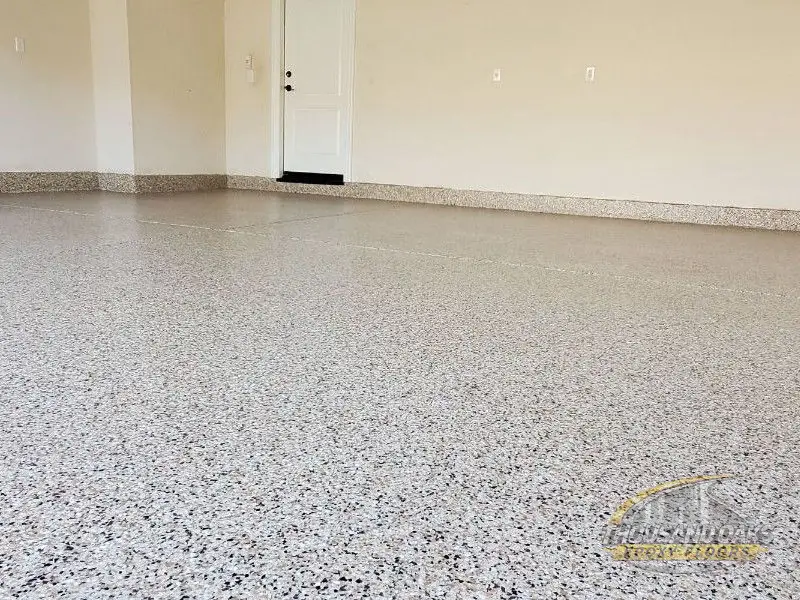
When Can I Walk on My New Epoxy Floor?
On a flake floor with a polyaspartic topcoat, the same evening. Socks or clean shoes are best for the first night. Solid color and metallic floors take longer because each layer needs to cure before the next goes on; you are usually off the floor for 24 hours after the final coat.
When Can I Drive on an Epoxy Garage Floor?
We say 48–72 hours for parking on a flake system. That gap matters more than people think. The topcoat may feel hard to the touch in a few hours, but it is still building cross-link density, and a heavy tire turning in place on day one can mark it. In hot weather, like a July week in Simi Valley or Moorpark, the cure is on the faster end. In a cool, damp November in Newbury Park, wait the full 72 hours.
| Milestone | Flake (1-day) | Solid color | Metallic |
|---|---|---|---|
| Light foot traffic | Same evening | ~24 hrs after final coat | ~24 hrs after final coat |
| Put storage back | 24 hrs | 48 hrs | 48 hrs |
| Park cars | 48–72 hrs | 72 hrs | 72 hrs |
| Full chemical resistance | ~7 days | ~7 days | ~7 days |
Full chemical resistance takes about a week. Until then, wipe up spills promptly and do not leave a leaking car sitting on the new floor.
How Long Does Installation Take?
- Flake epoxy: 1 day for most two- and three-car garages.
- Grind and seal: 1–2 days.
- Quartz: 2–3 days.
- Solid color: about 3 days.
- Metallic: 3–4 days.
A one-day flake install usually starts around 7:30 or 8 in the morning with grinding and dust collection, then crack repair, the basecoat, the flake broadcast, scraping and vacuuming, and the topcoat in the afternoon. The time depends on square footage and how much prep the slab needs.
Can a Worn Floor Be Refreshed Instead of Replaced?
Usually, yes. If the bond to the concrete is sound and the floor is just dull or lightly scratched in the traffic lanes, we can scuff-sand the existing topcoat and apply a fresh one. That costs far less than a new floor. If the coating is peeling, bubbling or lifting at the edges, the bond has failed and it has to come off, which is priced as coating removal on a new installation.
How Do I Make My Floor Last Longer?
- Dust-mop or blow out grit weekly.
- Clean with water and a pH-neutral cleaner. Skip vinegar, citrus degreasers and bleach-heavy products.
- Put a mat at the entry and under the spot where the car drips.
- Use pads under jack stands, motorcycle stands and heavy furniture.
- Hose and squeegee after rain or a muddy trail ride.
What Should I Do the First Week?
Day one, stay off it except to check it in socks. Day two, you can bring back light storage like bins and bikes, but keep heavy shelving and the fridge out until day three. When you park for the first time, roll in straight and avoid turning the steering wheel while the car is stopped; a tire twisting in place is the hardest thing on a young topcoat. Leave the garage door cracked a few inches if the weather is warm so solvent smell clears. If a drip lands on the floor that week, blot it rather than scrubbing. After seven days, treat it like any finished floor.
Signs Your Floor Is Near the End
Look for chips at the edges of control joints, white haze or wear through to color in the tire lanes, small blisters, and peeling at the door threshold. The first two mean it is time for a topcoat refresh. Blisters and peeling mean the bond has failed and the floor needs removal and a new system.
Does Our Climate Shorten the Life of an Epoxy Floor?
Not if the system is right. Thousand Oaks garages do not see road salt or freeze-thaw, which is what destroys floors back east. Our challenges are sun, heat and, closer to the coast, moisture. A UV-stable topcoat and a moisture reading before the basecoat cover all three.
If you want a realistic lifespan for your own garage, the best place to start is a slab check. We take moisture readings, look for old coatings and cracks, and tell you which build fits. Book a free estimate or call (805) 521-6591.
Frequently Asked Questions
How long does an epoxy garage floor last?
A diamond-ground epoxy floor with a full flake broadcast and a polyaspartic topcoat typically lasts 15 years or more in a home garage. DIY one-coat kits often last only 1–3 years.
How long after an epoxy garage floor can you drive on it?
On our flake floors, park after 48–72 hours. You can walk on it the same evening. Full chemical resistance takes about seven days.
How long does epoxy take to cure?
A polyaspartic-topped flake floor is walkable in hours and ready for cars in 48–72 hours. Epoxy-only floors and metallic pours need longer between coats, which is why they take 3–4 days to install.
Can an old epoxy floor be recoated?
Yes, if it is still bonded. We sand the existing topcoat and apply a new one. If it is peeling or bubbling, the old coating must be removed first.